The Challenge
In lubricant and specialty-fluid blending, the finished product is only as good as the recipe, and the recipe depends on dosing each additive by exact volume. A viscosity-index improver, a detergent package, or an anti-wear additive may make up only a few percent of a batch, but a dosing error of even one or two percent can push the blend out of specification. When that happens, the choice is expensive: rework the batch or scrap thousands of gallons of finished product.
These types of fluids are difficult for most flow measurement technologies because:
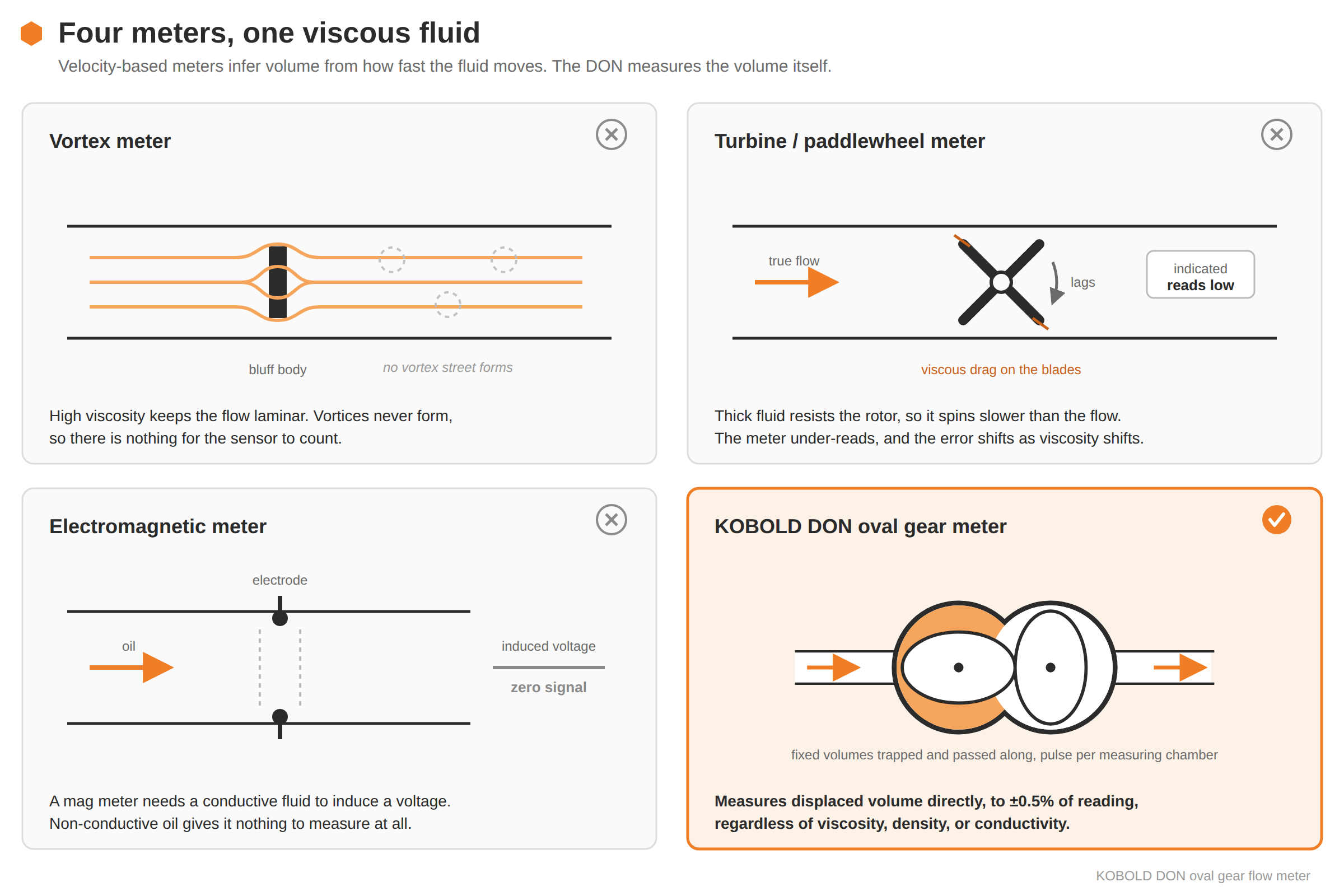
- High viscosity tends to keep the flow profile laminar. A vortex meter depends on vortices created by a bluff body placed in the flow path, and those vortices form only when the flow is turbulent. Thick fluid holds the Reynolds number low and keeps the flow smoothly laminar, so heavy oil often never reaches the regime the meter depends on, leaving it with no clean signal to count.
- High viscosity creates drag on turbine and paddlewheel meters. These meters infer flow rate from how fast a rotor turns, but a viscous fluid resists that motion and the rotor lags behind the true flow. The meter reads low, and the size of that error depends on the viscosity of the fluid moving through it.
- Temperature keeps changing the viscosity the meter was set up for. The meter carries a built-in assumption about the fluid’s viscosity, fixed at the moment it is calibrated. Because oil viscosity swings with temperature, the real fluid drifts away from that reference point whenever the line warms or cools, and the reading drifts with it, quietly and without any alarm.
- Non-conductive oil is invisible to a magnetic meter. An electromagnetic flow meter needs a conductive medium to produce a signal at all; run oil through one and it has nothing to measure.
Why Conventional Meters Fall Short
Most flow technologies are velocity-based: they don’t measure volume directly. Instead, they measure how fast the fluid moves, whether through the voltage a flow induces, the frequency at which vortices shed, or the speed at which a rotor spins, and then infer volume by multiplying that velocity by the cross-sectional area of flow. Every one of those inferences carries an assumption about the fluid: that it conducts, that it’s turbulent, that its viscosity and density hold steady. Viscous additives break those assumptions, leaving most velocity-based meters unable to measure reliably, if at all.
The Solution: Measure the Volume Directly
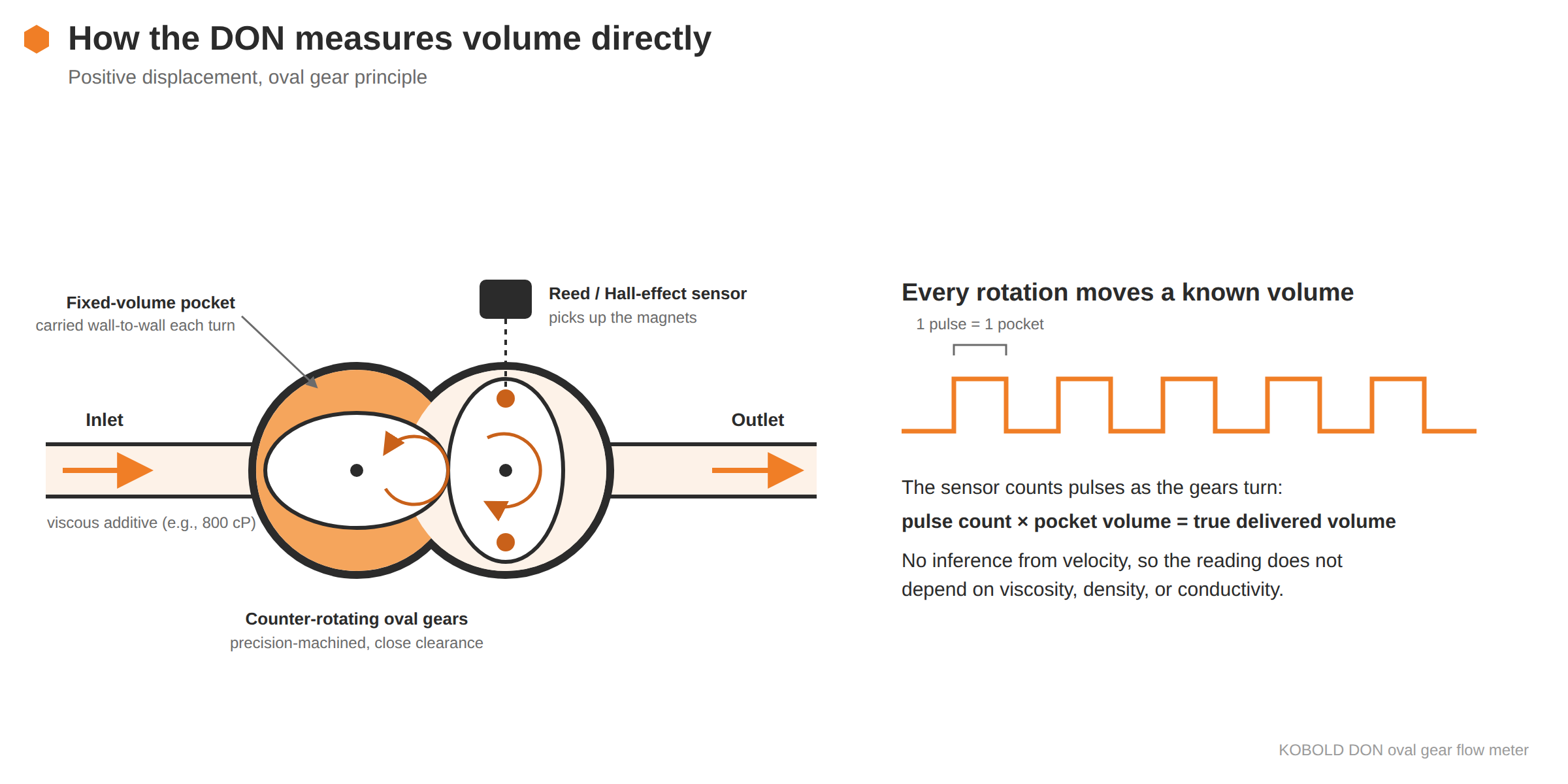
A positive displacement oval gear meter doesn’t infer anything. As liquid flows through the KOBOLD DON, two precision-machined oval gears rotate inside a measuring chamber, and each rotation carries a fixed, known volume of liquid from inlet to outlet. Magnets embedded in the gears are picked up by Reed or Hall-effect sensors, producing a high-resolution pulse train in which every pulse equals a defined volume. Count the pulses and you have the true displaced volume, independent of the fluid’s conductivity, density, or viscosity.
An Illustrative Example
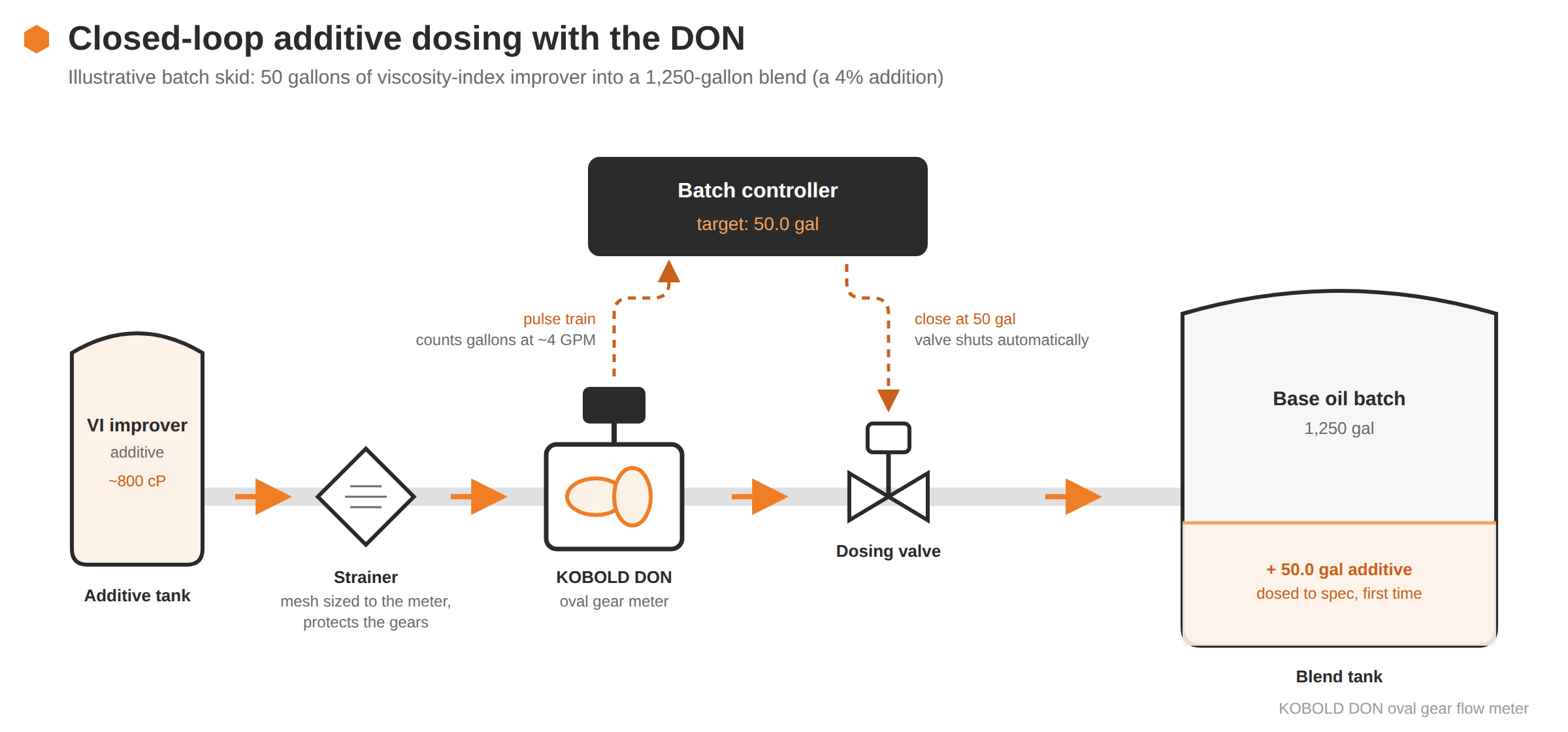
A blending plant needs to dose a viscosity-index improver into base oil on a batch skid. The additive runs at roughly 800 cP at line temperature. The dosing target is 50 gallons into each 1,250-gallon batch, representing a 4% addition with a tight overall tolerance target.
A DON is plumbed into the additive line ahead of the blend valve, sending its pulse output to a batch controller. The operator enters 50 gallons; the controller opens the dosing valve, counts pulses as the additive flows at about 4 GPM, and closes the valve automatically when the target volume is achieved. Because the meter reads true volume to an accuracy on the order of ±0.5% of reading, the dosing lands on target irrespective of media condition changes. Adding the U-PACE electronics option lets the same device report additive temperature alongside flow and communicate over IO-Link, so the blend station logs a complete record of every dose.
The Results
- Batches land in spec the first time, cutting rework and scrap driven by silent dosing drift and inaccurate measurements.
- Accuracy holds as conditions change, because volumetric measurements don’t depend on viscosity, density, or conductivity.
- The dosing record is auditable: pulse totals, batch counts, and temperature (with U-PACE), delivered to the PLC or SCADA layer.
- The skid stays compact. The DON requires no upstream or downstream straight pipe runs, so it drops into tight dosing manifolds where a long meter run simply won’t fit.
KOBOLD DON Specification Highlights
| Attribute |
DON capability |
| Principle | Positive displacement, oval gear |
|---|
| Flow range | 0.13 GPH to 660 GPM across the series |
|---|
| Accuracy | ±0.2% to ±1% of reading, by model and electronics |
|---|
| Viscosity | Up to 1,000 cP with standard rotors; special cut rotors for up to 30,000 cP |
|---|
| Materials | Aluminum (fuels, fuel oils, lubricating liquids) or 316L stainless steel (chemicals and aggressive media) |
|---|
| Connections | 1/8" to 4"; threaded (NPT) or flanged (ASME 1"–4"), BSP and DIN also available |
|---|
| Pressure | Up to 1450 PSIG on smaller and stainless models |
|---|
| Temperature | −4 °F to 302 °F, depending on seals and electronics |
|---|
| Outputs | Pulse/frequency, 4–20 mA, switch contacts, LCD totalizer, batch controller, or U-PACE electronics with IO-Link and temperature measurement |
|---|
| Installation | No straight pipe runs required |
|---|
Getting It Right: Application Notes
The DON is built for clean, non-abrasive liquids, so an upstream strainer is essential. The filtration mesh is specified by meter size to protect the gears from particulates. On very viscous media, the maximum flow rate is derated according to KOBOLD’s published multiplier table, so size the meter to the additive’s actual line-temperature viscosity rather than its nominal value. Match the body material to the fluid: aluminum for oils and fuels, 316L stainless for chemically aggressive additives.
Talk to KOBOLD
If you’re dosing, batching, or totalizing a viscous, non-conductive liquid and your current meter struggles to produce accurate results or drifts with temperature, the DON oval gear flow meter is built for exactly that problem. Contact a KOBOLD application engineer to size a meter to your fluid, flow range, and control architecture.
Common Questions about Precise Viscous Fluid Dosing with the KOBOLD DON Oval Gear Flow Meter
Frequently Asked Questions
A vortex meter depends on vortices created by a bluff body placed in the flow path, and those vortices form only when the flow is turbulent. High viscosity holds the Reynolds number low and keeps the flow smoothly laminar, so heavy oil often never reaches the regime the meter depends on, leaving it with no clean signal to count.
These meters infer flow rate from how fast a rotor turns, but a viscous fluid resists that motion and the rotor lags behind the true flow. The meter reads low, and the size of that error depends on the viscosity of the fluid moving through it.
No. An electromagnetic flow meter needs a conductive medium to produce a signal at all; run oil through one and it has nothing to measure.
As liquid flows through the DON, two precision-machined oval gears rotate inside a measuring chamber, and each rotation carries a fixed, known volume of liquid from inlet to outlet. Magnets embedded in the gears are picked up by Reed or Hall-effect sensors, producing a high-resolution pulse train in which every pulse equals a defined volume. Count the pulses and you have the true displaced volume, independent of the fluid’s conductivity, density, or viscosity.
Up to 1,000 cP with standard rotors, with special cut rotors for up to 30,000 cP. On very viscous media, the maximum flow rate is derated according to KOBOLD’s published multiplier table, so size the meter to the additive’s actual line-temperature viscosity rather than its nominal value.
No. The DON requires no upstream or downstream straight pipe runs, so it drops into tight dosing manifolds where a long meter run simply won’t fit.
Last Updated: