All About Conductive Level Switches
Knowing how much liquid sits inside a tank is one of the most basic requirements in industrial process control, and one of the easiest to get wrong. Overflows, dry-running pumps, and inaccurate batches all trace back to a simple question that is surprisingly hard to answer reliably: has the liquid reached a certain level, or hasn't it? Conductive level switches detect the presence or absence of a conductive liquid at a fixed point, providing a clear, dependable signal with no moving parts and minimal maintenance. When the liquid touches the electrode, it completes a low-voltage circuit, the resistance between the electrodes decreases, and the switch changes state. With no moving parts to stick, jam, or wear out, conductive level switches are among the most economical and lowest-maintenance level instruments available, provided the liquid can conduct electricity.
The same device goes by several names: conductivity level switch, conductive level sensor, electrode level switch, or simply a level electrode. Whichever name you've encountered, they all describe the same instrument, and everything in this guide applies to all of them.
In this guide, we'll cover how conductive level switches work, which liquids they can and can't detect, how they control pumps automatically, how they compare to float and capacitive switches, and how to choose the right one for your application.
How Does a Conductive Level Switch Work?
A conductive level switch works by applying a low AC voltage to one or more metal electrodes mounted in a tank. When conductive liquid rises high enough to touch an electrode, the liquid completes the electrical circuit between that electrode and a ground reference. A relay detects the small current flow or the decrease in electrical resistance and switches its output. When the level drops and the circuit opens again, the relay switches back.
Think of it like a light switch with one twist: instead of a finger flipping the switch, the liquid itself is the switch. The liquid acts as the missing piece of wire that closes the loop. If the liquid is there, current flows; if it isn't, current can't flow.
The circuit needs two points of contact. The first is the sensing electrode, set at the level you want to detect. The second is the ground reference: in a metal tank, the tank wall itself can serve this role, while in a plastic, fiberglass, concrete, or other type of non-conductive tank a reference electrode is added so the circuit can be completed.
Sensing electrodes are typically clad in an insulating material, leaving only a short bare tip, about ¼ inch on the KOBOLD NE, exposed to the liquid. The cladding ensures the circuit can only close through liquid at the tip, not through condensation near the fitting, a film left behind as the level drops, foam, or an adjacent electrode. On a multipoint probe, where several electrodes run side by side through the same headspace, that insulation is what keeps each switch point independent. On the rigid NE, electrodes are available fully clad in polyolefin (to 190°F) or in PTFE (to 300°F), though not every cladding is offered with every electrode material. The PTFE cladding is also available as a partial sleeve that insulates the upper section of the rod near the fitting, where condensation and film tend to collect, while leaving the lower portion bare. On the cable-suspended NEH, the electrodes hang on neoprene-clad cables with PVC-coated weights (to 140°F) or PTFE-clad cables with PTFE-coated weights (to 300°F).
The electrical energy involved is tiny. These devices apply a low voltage, low current signal that is safe and does not impact the process. The voltage is alternating current by design: a DC voltage on a submerged electrode would slowly corrode through electrolysis and could plate deposits onto the metal, while a low AC voltage keeps the electrode surface stable over years of service. An adjustable sensitivity setting lets the switch ignore weakly conductive films and other false readings and respond only to the liquid itself.
What Is an Electrode Relay and Why Do You Need One?
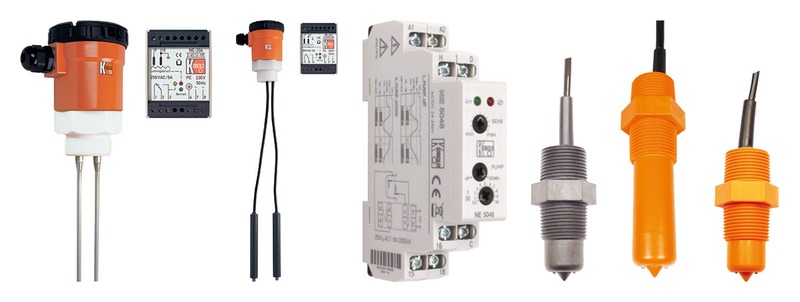
The electrodes in the NE and NEH conductive level switches are passive metal rods; they contain no electronics at all. The sensing and control element lives in a separate device called an electrode relay, which supplies the safe low voltage to the electrodes, senses the tiny current that flows when liquid touches them, and switches a real electrical contact in response. That contact is what actually sends the signal to a PLC or other control device.
Splitting the system this way is a quiet advantage of the technology: the only thing inside the tank is the probe, while all the electronics sit safely in a control panel, away from heat, pressure, and corrosive vapors. In a typical KOBOLD system, NE rigid electrodes or NEH cable-suspended electrodes go into the tank, and the electrode relay mounts on a standard DIN rail in the control panel to power them and do the switching.
Because electrodes are just rods of different lengths sharing one fitting, a single conductive level switch installation can monitor several levels at once. KOBOLD's NE and NEH support multiple independent switch points from one tank opening; for example, a dry-run cutoff, a pump-on point, a pump-off point, and a high-level overflow alarm, all from one multipoint probe. Keep in mind that each independent output (level setpoint or pump-control loop) needs its own relay channel.
The most popular electrode relay offered by KOBOLD is the NE-104 series. Depending on the specific model, it accepts a 24 VAC, 110 VAC, or 230 VAC power supply and outputs a maximum of 10 VAC at a maximum of 0.5 mA to the electrodes. The unit provides one potential-free SPDT contact capable of switching up to 250 VAC, 5 A, 600 VA. The device has a typical response time of approximately 1 second and its sensitivity is adjustable from 0-50 kΩ to match the conductivity of the liquid.
The NE-5048 is another electrode relay offered. It accepts 24-240 VAC/DC with a power consumption of 2 VA / 1.5 W. The maximum electrode voltage is 3.5 VAC with a current of less than 0.1 mA. It offers one potential-free change-over contact selectable as normally open or normally closed and capable of switching up to 250 VAC, 8 A, 2000 VA. The relay has a response time of 400 ms with a switch on delay of 1.5 s and an adjustable switch off delay from 0.5 to 10 s which prevents splashing or turbulence from causing false trips. Its sensitivity is adjustable from 5-100 kΩ to match the conductivity of the liquid.
How Do Conductive Level Switches Control Pumps Automatically?
Conductive level switches control pumps using two detection points. One electrode is set at the low level and one at the high level. In a filling application, the pump switches on when liquid falls below the low electrode and off when it reaches the high electrode. In an emptying application, the logic simply reverses.
The key is that in this configuration, the relay latches between the two points rather than reacting to a single level. If a pump switched on and off at one point, it would rapid cycle every time the level hovered near the electrode, which is hard on the motor and the contacts. Latching between a low and a high point gives the pump a full, useful run each time it starts. It's the same reason your home thermostat doesn't switch the furnace on and off every thirty seconds.
What Liquids Can a Conductive Level Switch Detect?
Conductive level switches work with electrically conductive liquids. KOBOLD's NE and NEH require a minimum conductivity of 20 µS/cm (down to 10 µS/cm with the NE-5048 electrode relay). Tap water, well water, seawater, wastewater, acids, caustics, and most aqueous chemical solutions easily qualify. Oils, fuels, solvents, and purified water (deionized, distilled, RO, etc.) do not, and a conductive level switch cannot detect them.
Conductivity is measured in microsiemens per centimeter (µS/cm). The higher the number, the more easily the liquid carries current. The 10-20 µS/cm minimum is a very low bar for most real-world liquids: ordinary tap water typically measures in the range of about 50 to 800 µS/cm, depending on its mineral content.
Liquids that work well:
- Potable water, well water, and gray water
- Wastewater and sewage, including dirty liquids with suspended solids
- Acids and caustics (with appropriate electrode materials)
- Water-based process and rinse solutions
Liquids that don't:
- Oils, fuels, and other hydrocarbons
- Most organic solvents
- Purified and ultra-pure water, whose conductivity is intentionally close to zero
What Are the Advantages of Conductive Level Switches?
The strengths of the technology all trace back to its simplicity, a circuit that the liquid itself completes:
- No moving parts. Nothing floats, pivots, or slides, so there is nothing to stick or wear out, which is a real advantage in dirty liquids that jam mechanical floats.
- No calibration. The switch detects presence or absence of liquid; there is no measuring range to configure.
- Low cost. Conductive switches are consistently among the most economical point level technologies available.
- Multiple switch points from a single tank opening with up to six electrodes on the KOBOLD NE and NEH.
- Electronics out of the process. Only electrodes contact the liquid; the relay sits in the control panel.
- Material options for harsh service: 316Ti stainless steel, Hastelloy C, or titanium electrodes, with polyolefin (to 190°F) or PTFE (to 300°F) insulating cladding that both guards against false signals and adds chemical resistance.
What Are the Disadvantages of Conductive Level Switches?
The limitations trace back to the same working principle; the liquid has to carry current:
- Conductive liquids only. Oils, solvents, and purified water (deionized, distilled, RO, etc.) are invisible to the switch. This is the deciding constraint: if your liquid doesn't conduct, choose another technology.
- Coating and build-up. A thick or sticky medium can leave an insulating layer on the electrode that delays or blocks detection. Sensitivity adjustment helps with thin films, but heavily coating media are better served by another technology.
- Electrode compatibility. Aggressive chemicals demand the right electrode alloy and cladding; a mismatched material will corrode over time.
- Non-metallic tanks need a reference electrode, since there is no conductive tank wall to complete the circuit.
- Conductive foam can, in some processes, bridge the electrode and cause an errant signal.
Conductive vs. Magnetic Float Level Switches: Which Should You Choose?
Magnetic float switches detect level mechanically: a buoyant float rises with the liquid, and an embedded magnet activates a switch. They work with nearly any liquid, conductive or not, which makes them the default choice for oils and fuels. Their weakness is the moving part itself. In dirty, viscous, or particulate-laden liquids, floats can foul, stick, or jam.
Conductive level switches flip that trade-off. They are limited to conductive liquids, but with no moving parts they shrug off exactly the dirty, particle-laden, corrosive water-based media that give floats trouble, which is why they are a mainstay of wastewater pump control.
Conductive vs. Capacitive Level Switches: What's the Difference?
Capacitive level switches detect the change in electrical capacitance that occurs when liquid surrounds a probe. No current needs to flow through the liquid, so they work with non-conductive media like oils and solvents. That flexibility comes at a higher price point and, for some models, a setup or calibration step.
For conductive liquids (water, wastewater, most aqueous chemicals) the conductive switch does the same job for less. The capacitive switch earns its premium when the liquid is non-conductive.
What Applications Use Conductive Level Switches?
Conductive level switches appear almost anywhere a water-based liquid needs a reliable high-level alarm, low-level alarm, or automatic pump control:
- Water and wastewater treatment: pump up/pump down control in lift stations, sumps, and clearwells, as well as overflow protection on basins.
- Chemical processing: level alarms on acid and caustic day tanks, using Hastelloy or titanium electrodes with PTFE cladding for chemical resistance.
- OEM equipment: washers, cooling loops, and other machines that need a compact, low-cost way to detect water level.
How Do You Install a Conductive Level Switch?
Installing an electrode level switch is usually a matter of mounting the probe vertically through the top of the tank, wiring the electrodes to the relay in the control panel, and setting the sensitivity. Rigid-electrode models like the KOBOLD NE suit tanks where a fixed probe of the right length can reach the switch points. For deep tanks, wet wells, and lift stations, the cable-suspended KOBOLD NEH lowers weighted electrodes on flexible cable up to 100 feet long (30 feet for PTFE cables), reaching depths well beyond the NE's 120-inch maximum electrode length. On both the NE and NEH, electrode lengths are made to order, so each switch point is set exactly where your application needs it.
A few practical rules of thumb: position electrodes away from the incoming fill stream and heavy agitation so waves don't cause nuisance trips; in a non-metallic tank, remember to order the reference electrode; and match the electrode material and cladding to the chemistry of the liquid. Because the electrodes are passive, wiring is simple low-voltage signal wiring back to the relay.
What Can Go Wrong with a Conductive Level Switch?
Very little mechanically, as there are no moving parts to wear out. The problems that do occur are almost always electrical or chemical rather than mechanical: an insulating coating on the electrode, corrosion from a mismatched electrode material, or nuisance trips from splashing. Each has a known cause and, usually, a simple fix.
- The switch doesn't detect liquid. Checking the sensitivity setting is the first step. It may simply be set too low for a weakly conductive liquid. If that doesn’t solve the issue the liquid's conductivity could be below the minimum, a coating could be insulating the electrode, or the device may have been installed in a non-conductive tank without a reference electrode.
- The switch triggers when it shouldn't. Condensation or a conductive film bridging the electrode fitting, or agitation or splashing from the fill stream reaching the electrode, are the usual causes. Adjusting the sensitivity, adding relay time delay if possible, repositioning the electrode away from turbulence, or specifying fully clad electrodes typically resolves it.
- The electrode is corroding. This points to a material mismatch with the liquid. The fix is stepping up from stainless steel to Hastelloy C or titanium.
- A pump is short-cycling. This usually means the system is switching on a single level point instead of latching between a low and a high electrode. Two-point control is the remedy, not a new switch.
How Much Does a Conductive Level Switch Cost?
Conductive level switches sit at the economical end of the level measurement market. They typically cost less than capacitive, ultrasonic, or radar instruments, and can be competitive with float switches.
What's the Difference Between the KOBOLD NE, NEH, and NEK?
All three detect conductive liquids the same way; they differ in design and where they fit:
- NE - the rigid-electrode workhorse. Electrodes in 316Ti stainless with polyolefin or PTFE cladding, or in Hastelloy C or titanium with PTFE cladding (full or partial). Available with stainless steel, PP, or PTFE fittings and a polycarbonate, polyamide, or aluminum housing depending on the specific model. Rated up to 440 PSIG (stainless fitting) and 300°F (PTFE cladding), with up to six switch points from one fitting. The choice for pressurized vessels and higher-temperature service.
- NEH - the deep-tank specialist for wet wells, lift stations, and tall tanks. The same electrode principle on weighted, flexible neoprene cables up to 100 feet (30 feet for PTFE cables), with PP or PTFE fittings and a polycarbonate or aluminum IP65 housing, rated up to 90 PSIG and 300°F depending on the configuration.
- NEK - the compact, self-contained option. A ¾" NPT, IP68-rated switch, in a PP or PPS body. The electronics are built in, delivering a PNP, NPN, or SPDT relay output directly (no separate electrode relay required). Suitable for dirty, low-viscosity, or aggressive conductive liquids at up to 290 PSIG and 185°F in the PPS body and 87 PSIG and 140°F in the PP body.
How Do I Choose a Conductive Level Switch?
Four questions settle most selections:
- First, is the liquid conductive? Is it water-based, with conductivity of at least 10-20 µS/cm?
- Second, what are the temperature and pressure of the process, which determine electrode cladding and body materials?
- Third, how many switch points do you need? A single alarm, or multipoint pump control?
- Fourth, what is the tank made of, and how deep is it? That determines rigid versus cable-suspended electrodes and whether you need a reference electrode.
If any of those answers are unclear, that's what we're here for. KOBOLD's engineers help with product selection every day, at no charge. Send us your application details or schedule a free engineering consultation, and we'll make sure the switch you order is the right one the first time.
Common Questions about Conductive Level Switches
No. Oils, fuels, and solvents do not conduct electricity, so they cannot complete the circuit a conductive level switch depends on. For non-conductive liquids, a magnetic float, vibrating, optical, or capacitive level switch is the appropriate choice; conductive switches are for water-based, conductive media only.
Yes. While a metal tank wall can serve as a ground reference, in a non-conductive tank made of materials such as plastic, fiberglass, or concrete a separate reference electrode is required. The reference electrode extends below the lowest sensing electrode to provide a ground reference. The circuit then completes through the liquid between the sensing and reference electrodes, and the switch works exactly as it would in a metal tank. Note that a reference electrode can be used in a metal tank as well if preferred over using the tank wall.
No. A conductive level switch detects the presence or absence of liquid at a fixed point, so there is no measuring range to calibrate and nothing to drift. At most, you set an adjustable sensitivity once at commissioning to match the conductivity of your liquid, and a time delay to prevent premature switching from agitation or level fluctuations around the switch point, if available with the chosen relay.
KOBOLD's NE and NEH multipoint models support up to six independent switch points from a single tank fitting. Electrodes of different lengths each detect their own level. That allows multiple different configurations and control schemes from one probe assembly and one tank opening. For non-conductive tanks, one of the electrodes will need to serve as a reference electrode, limiting the device to five independent switch points.
Conductivity, measured in microsiemens per centimeter (µS/cm), describes how easily a liquid carries electrical current. KOBOLD's NE and NEH need at least 20 µS/cm (down to 10 µS/cm with the NE-5048 electrode relay) to detect a liquid reliably. Most water-based liquids easily exceed that limit; purified water (deionized, distilled, RO, etc.), oils, and solvents generally fall below that limit and cannot be detected.
The relay outputs are not recommended to drive pumps directly. Pumps are typically switched through a motor starter or contactor, with the level switch relay providing the control signal.
Yes. KOBOLD's NE, NEH, and NEK conductive level switches are manufactured in the USA.
No. The names are easy to confuse. A conductivity sensor (or conductivity probe/meter) measures how conductive a liquid is, in µS/cm, as a continuous output. A conductive level switch merely uses conductivity to detect whether liquid is present at a particular point. A "conductivity level switch," however, is the same thing as a conductive level switch.
A thin conductive film is usually ignored by adjusting the switch's sensitivity. A thick, sticky, or insulating coating, however, can delay or block detection, because it prevents proper contact between liquid and electrode.
Published on: